I have to say, for the most part, people have been so supportive of my running. I have received so much encouragement and the donations made to my, thus far, two charities has gone beyond my expectations. And while it hasn't been easy, I would that running these marathons has been a very gratifying experience. A special thanks to my mom who continuously brings me new running shoes and running supplements.
However, there have been a few memorable, unique reactions, that I've gotten during my year of running. Let me share them with you now, through the universal language of cats.
1. The Super Excited Un-Solicited Running Buddy
2. The Horrified Friend
3. The Annoyed Facebook Friend
4. The Amazed "I know nothing about running" Person
5. The Forlorn Drinking Buddy
6. The Fitness Skeptic
7. The Empathizer
8. The Wistful Ex-Runner
9. The Judgementalist
10. The Dramatic Self-Criticizer
11. The Random Horror-Story Teller
12. The Information Seeker
13. The Dream Crusher
And my reaction to everyone, everywhere, is...
Go to my First Giving Donation page HERE to donate to the Hydrocephalus Association today!
Countdown to Dublin: 43 days!
Monday, September 17, 2012
Sunday, September 9, 2012
Getting to Know ... Hyrocephalus (part 2)
What
are the symptoms of hydrocephalus?
Symptoms of hydrocephalus depend on age,
disease progression, and individual differences in tolerating the condition. In infancy, hydrocephalus presents
itself with a rapid increase in head circumference due to buildup of CSF which
pushes the unfused skull sections outwards. Other symptoms may include vomiting,
sleepiness, irritability, downward deviation of the eyes (also called
"sunsetting"), and seizures.
Older children and adults can experience
different symptoms because their skulls cannot expand to accommodate the
buildup of CSF. Symptoms of congenital hydrocephalus include headache
followed by vomiting,
nausea,
papilledema (swelling of the optic disk which is part of the optic nerve),
blurred or double vision,
sunsetting of the eyes, problems with balance, poor coordination, gait
disturbance, urinary
incontinence, slowing or loss of developmental progress, lethargy,
drowsiness, irritability, or other changes in personality or cognition including memory loss.
Symptoms of normal pressure
hydrocephalus, which primarily occurs in elderly individuals, include problems walking,
impaired bladder control, and progressive mental impairment and dementia.
Because some of these symptoms may also be experienced in other disorders such
as Alzheimer's
disease, Parkinson's disease, and Creutzfeldt-Jakob disease, normal
pressure hydrocephalus is often incorrectly diagnosed and never properly
treated. Doctors may use a variety of tests, including brain scans (CT
and/or MRI),
a spinal tap
or lumbar catheter, intracranial pressure monitoring, and neuropsychological
tests, to help them accurately diagnose normal pressure hydrocephalus and rule
out any other conditions.
What is the current treatment for hydrocephalus?
Hydrocephalus is usually treated by surgically inserting a shunt system. This system diverts the flow of CSF from the CNS to another area of the body where it can be absorbed as part of the normal circulatory process.
A shunt is a flexible but sturdy plastic tube. A shunt system consists of the shunt, a catheter, and a valve. One end of the catheter is placed within a ventricle inside the brain or in the CSF outside the spinal cord. The other end of the catheter is commonly placed within the abdominal cavity, but may also be placed at other sites in the body such as a chamber of the heart or areas around the lung where the CSF can drain and be absorbed. A valve located along the catheter maintains one-way flow and regulates the rate of CSF flow.
A limited number of individuals can be treated with an alternative procedure called third ventriculostomy. In this procedure, a neuroendoscope — a small camera that uses fiber optic technology to visualize small and difficult to reach surgical areas — allows a doctor to view the ventricular surface. Once the scope is guided into position, a small tool makes a tiny hole in the floor of the third ventricle, which allows the CSF to bypass the obstruction and flow toward the site of resorption around the surface of the brain.
What research is being done for hydrocephalus?
The National Institute of Neurological Disorders and Stroke (NINDS) and other institutes of the National Institutes of Health (NIH) conduct research related to hydrocephalus in laboratories and clinics at the NIH and support additional research through grants to major medical institutions across the country. Much of this research focuses on finding better ways to prevent, treat, and ultimately cure disorders such as hydrocephalus. The NINDS also conducts and supports a wide range of fundamental studies that explore the complex mechanisms of normal and abnormal brain development.
There is still a lot about hydrocephalus that doctors don’t know. While there is no cure, treatments are available to help alleviate hydrocephalus symptoms, prevent future brain complications, and even reverse damage resulting from hydrocephalus. Children and adults with normal pressure hydrocephalus can benefit from various rehabilitation therapies and, with minor treatments, can lead completely normal lives. However, progressive hydrocephalus can be fatal if left untreated.
What can you do? DONATE TO THE HYDROCEPHALUS ASSOCIATION TODAY! CLICK HERE!!! 100% of all donations go towards hydrocephalus research. Help support medical studies and testing to make hydrocephalus a thing of the past! And thank you to all of you who have already donated.
Sunday, September 2, 2012
Getting to know...Hydrocephalus (part 1)
What
is hydrocephalus?
The
word hydrocephalus is a condition where fluid in the brain builds up to excessive
and dangerous amounts. Hydrocephalus comes from the Greek words “hydro”,
meaning water, and “cephalus”, meaning head. This brain fluid is called cerebrospinal
fluid (or CFS for short). CFS is a clear fluid that surrounds the brain and
spinal cord. CFS’s main functions are to keep the brain tissue healthy and buoyant
by acting as a “shock absorber” and deliver nutrients to the brain and then
help remove waste.
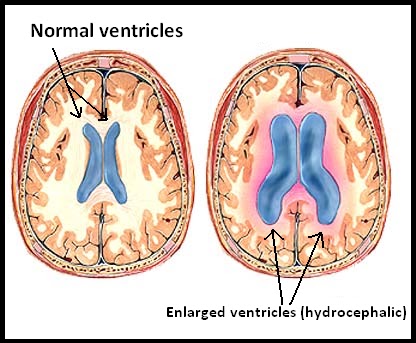
The
excessive accumulation of CSF results in an abnormal widening of spaces in the
brain called ventricles. This widening creates potentially harmful pressure on
the tissues of the brain. Normally, CSF flows through the ventricles, exits
into cisterns (closed spaces that serve as reservoirs) at the base of the
brain, bathes the surfaces of the brain and spinal cord, and then reabsorbs
into the bloodstream.
The
balance between production and absorption of CSF is very important. Because CSF
is made continuously, any medical condition that prohibits or hinders the re-absorption
and dissolution of CFS, like hydrocephalus, will result in painful pressure of
the fluid against the brain tissue.
Hydrocephalus
is either congenital or acquired. Congenital hydrocephalus, meaning it is
present at birth, may be caused by either events or influences that occur
during fetal development, or genetic abnormalities. Acquired hydrocephalus,
meaning the condition develops over time or later in life, can affect people at
any age and may be caused by injury or disease, such as head trauma, infection,
tumors, or surgical complications.
Hydrocephalus
may also be communicating or non-communicating. Communicating hydrocephalus
occurs when the flow of CSF is blocked after it exits the ventricles. This form
is called communicating because the CSF can still flow between the ventricles,
which remain open. Non-communicating hydrocephalus - also called
"obstructive" hydrocephalus - occurs when the flow of CSF is blocked
along one or more of the narrow passages connecting the ventricles. One of the
most common causes of hydrocephalus is "aqueductal stenosis." In this
case, hydrocephalus results from a narrowing of the aqueduct of Sylvius, a
small passage between the third and fourth ventricles in the middle of the
brain.
Next time,
we’ll talk about symptoms, research, and treatments. (p.s. all of this research
and information came from medicine.net and hydroassoc.org. Check them out for
more info!)
And
speaking of things you can do to help….
Have
you donated to the RunCarlaRun First Giving Donation Fund yet? 100% of all
donations go to the Hydrocephalus Association. We are only at 6% of our goal.
LET’S GO PEOPLE! Go HERE to donate NOW!
Sunday, August 26, 2012
Joys of training outside in August during 95 degree weather with 70% humidity
Also, GOOD NEWS! We have already raised $125 for the Hydrocephalus Association via my donation site on First Giving (click HERE to donate now!). That's 6% of our goal. Every little bit counts.
Coming next week....What IS Hydrocephalus?
Stay tuned.
Thursday, August 23, 2012
The Run Carla Run Project: Reloaded
And now the time has come my friends to talk of many things.
Of shoes and ships and ceiling wax and….CARLA IS RUNNING A MARATHON IN DUBLIN!?
Joy of joys! Are you ready for more hilarious blog posts and endless facebook
notifications from the RunCarlaRun Project? I bet you are. Ahhhhhhhh!
But why, I’m sure you’re all wondering (all 5 of you reading
this) am I running again? Why, when I so vehemently proclaimed that I would
never go running again, am I now lacing back up my shoes?
Well, it’s all for my wonderful, beautiful, smart, funny,
lovely niece Nicole. Nicole has recently been suffering from complications due
to hydrocephalus, or, in layman’s terms, “water on the brain”. She has had this
condition since infancy as the result of being born extremely premature. For the first 18 years of her life, she has lived a relatively normal
life with few medical interruptions. However, these past few months her hydrocephalus, which has been manageable up to this point, has now become very agitated and is causing her serious problems, such as severe headaches and seizures. This has necessitated surgery after surgery in hopes to correct the symptoms.
No long term solution has been achieved thus far by her various surgeons and
medical specialists. And while we’re all praying for her, I have decided to
show my support by running another marathon and blogging about hydrocephalus.
Just like I blogged
about Multiple Sclerosis and other autoimmune diseases while I prepared to run
the Rome Marathon last spring, for this marathon adventure I will blog about hydrocephalus
and other conditions premature babies can suffer from. Nicole is a real
survivor and has overcome a plethora of medical ailments with courage, grace,
dignity and a smile. She is one of the happiest and most generous people I
know. Her positive spirit and gentle soul cultivate joy everywhere she goes. It
is my honor to write about her here in this blog. I am very lucky to be her
aunt and I hope these words and all the blog posts that follow will lift her
spirits and give her the love and support she needs to keep soldiering on
during her time in and out of the hospital.
What else is making a return to this blog? Well more running
stories, obviously, and more cartoons, obviously, and…another charity donation
cause! I have set-up a site to make donations to the Hydrocephalus Association
via the FirstGiving donations site. Remember my last fundraising efforts with
JustGiving? Well, this is its US counterpart. 100% of all donations will go the
HA, plus, you get a thank you card from me! What more could you ask for? My
goal is $2000 US dollars this time around. Go HERE
to donate now!
Last but not least, Nicole has offered to contribute to my
blog! She is a major part of this fundraising campaign and I can’t wait to see
what she adds to the Run Carla Run Project.
So thank you to everyone who has supported me though all my
RCRP days. Let's see what this Irish adventure brings....
Subscribe to:
Posts (Atom)